Federated
Multi-Silo Masterclass.
Achieve 100% data isolation with a unified global view. GO-DUCK's Federated Architecture orchestrates multiple independent database silos into a single, high-performance empire.
The Foundations: Silos vs. Federation
S What is a "Silo"?
In database architecture, a Silo is a physically isolated storage unit. Unlike traditional multi-tenancy where all users share the same table (Soft-Tenancy), GO-DUCK uses Hard-Silo Isolation.
- Physical Separation: Each Silo is its own Database/Schema.
- Security: No risk of cross-tenant data leakage via
WHEREclause bugs. - Compliance: GDPR/HIPAA-ready dedicated storage paths.
F What is "Federation"?
Federation is the "Virtual Connectivity Layer" that sits above your Silos. It allows your application to treat 100 independent databases as a single Unified Empire.
- Aggregation: Query one endpoint, get results from every Silo.
- Orchestration: Broadcat a single write to multiple regions.
- Transparency: Front-end devs don't need to know which Silo they are hitting.
Case Study: The Dealership Empire
Imagine you are running a global car dealership. Every regional branch (USA, Germany, Japan) requires physical isolation for local accounting compliance, but your CEO needs a global stock report in real-time.
USA SILO
"Site-specific Inventory. Physically trapped in local DB."
UK SILO
"Isolated branch ops. No link to foreign data."
FEDERAL LAYER
"The Harvester. Aggregates USA + UK into a single API response."
Visualizing the Registry Logic
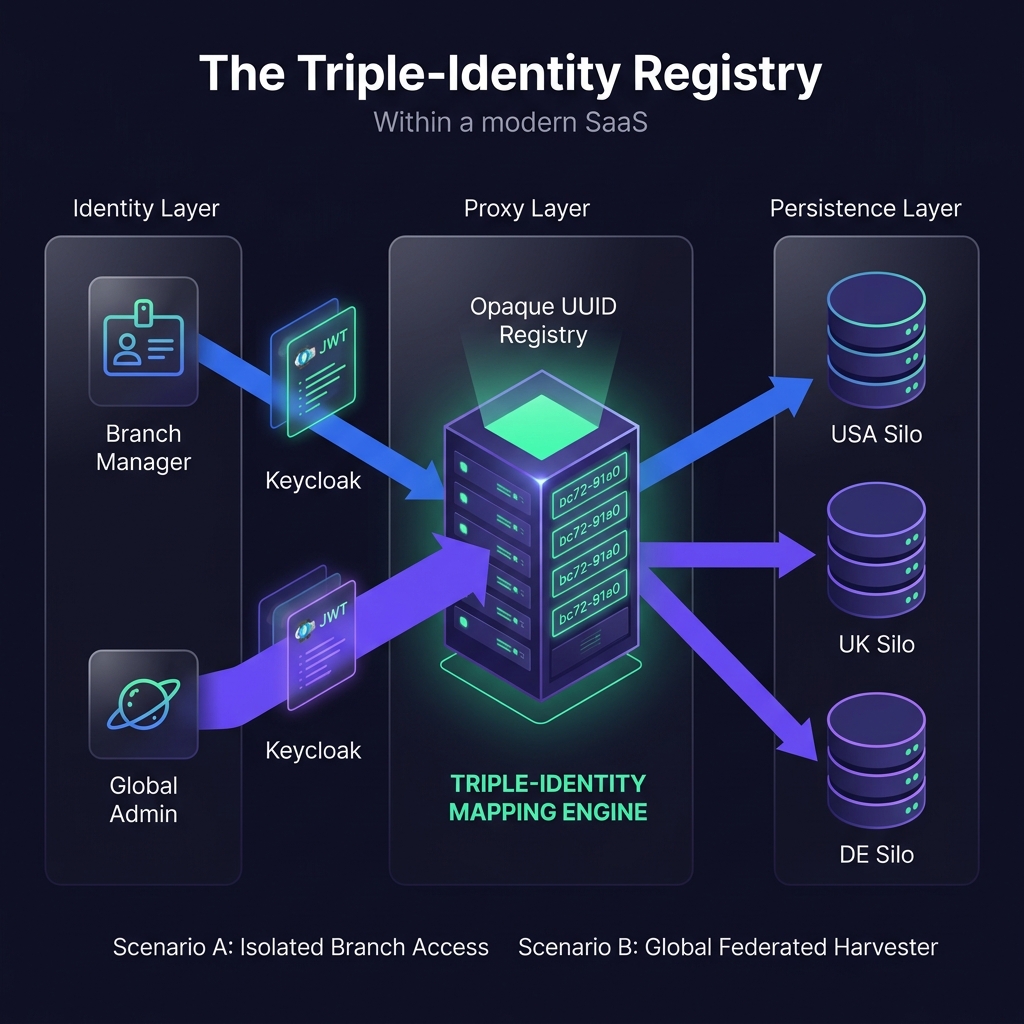
Scenario A: Isolated Branch
A Branch Manager (ID Layer) presents a token. The Triple-Identity Mapping Engine maps them to a single Opaque UUID. The logic strictly routes their connection to the USA Silo only. No other silos are visible or reachable.
Scenario B: Federated Harvester
A Global Admin (ID Layer) initiates a query with ?federated=true. The Mapping Engine validates their authority and fan-outs the request across USA, UK, and DE Silos simultaneously, harvesting and aggregating the collective state.
The Mapping Decoupling
GO-DUCK solves the "ID Enumeration" problem using an internal 3-layer mapping engine. This ensures that no internal database connection strings or IDs are ever exposed to the client.
1. Role Mapping
realm_role: 'branch_usa'
2. Opaque Proxy
UUID: 'bc72-...-a180'
3. Silo Routing
DB: 'car_dealership_usa'
The Control Plane: Runtime Provisioning
Zero-Touch Onboarding
GO-DUCK isn't just a static mapping. It includes a built-in SaaS Management Engine that can provision entire DB silos on the fly.
Triggering this endpoint creates the DB, registers the UUID mapping, and runs schema migrations in one atomic action. Gated behind JWT auth plus SuperAdminRoleMiddleware, so only your configured super-admin role can provision new silos.
Lazy Connection Management
To maintain elite performance, silos are Lazily Hydrated. Connection pools are only initialized upon the first incoming request for that Silo.
if pool := registry.Find(siloID); pool == nil {
registry.Hydrate(siloID); // Lazy Init
}
Precision Global Harvesting
Surgical Silo Selection
What if a user has access to 10 different silos but only needs to reconcile data from 3 specific regions?
GO-DUCK supports Precision Harvesting via the X-Tenant-ID header and the ?federated=true parameter.
X-Tenant-ID: uuid-1, uuid-2, uuid-3
The Parallel Harvester 2.0 detects the comma-separated list and reduces its concurrent fan-out to ONLY the intersected set of authorized silos.
authorized := user.GetSilos()
requested := header.GetTenants()
target := intersect(authorized, requested)
// Fan-out only to target
for silo := range target {
go harvest(silo)
}
Federated API Guide
| Action Type | Header / Params | Resulting Behavior |
|---|---|---|
| Standard Action | (None) | Dynamic routing to your assigned localized Silo. |
| Silo Narrowing | X-Tenant-ID: {UUID} | Force focus on a specific regional database silo. |
| Global Harvest | ?federated=true requires @Federated on the entity | Aggregates results from ALL silos in a single response. Both preconditions are required together — the annotation alone does not trigger fan-out. |
| Atomic Broadcast | (None — automatic) | Unconditional on every Create/Update/Delete/BulkX mutation to a @Federated entity — a DistributedOutbox row is written per authorized silo in the same transaction. There is no opt-in header; it always fires. |
Silo Discovery Endpoint
Curious which silos your identity resolves to? Ask the registry directly:
GET /api/silos/meReturns your Opaque UUID(s) via the Triple-Identity Registry. Note that whether the physical database name is also included depends on the multitenancy.hide-silo-names config flag — see the Multi-Tenancy guide for details.
Scale Without Data Leakage
Entities marked with @Federated automatically participate in this multi-silo orchestrator. Start your creation process today.